
Light Engines for Augmented Reality and Virtual Reality Technology
A new wave of wearable technology powered by photonic integrated circuits
Augmented reality (AR) glasses and virtual reality (VR) goggles face a primary challenge: they must become smaller, lighter, and more power-efficient. Our photonic integrated circuits (PICs) address this challenge head-on with light engines custom-made for efficient performance packed in compact, robust modules. This makes the AR light engines we make perfectly suited for the future!
Visible light waveguides are built into our TriPleX® silicon nitride. The ultra-low loss platform can propagate light at 405 nm to 750 nm (and beyond!) at minimal losses for AR light engines. In combination with its vertical and horizontal mode shaping capabilities it ensures that the bulk of your optical power go to the user.
The Future of AR, Envisioned With Brilliance
Brilliance is LioniX International’s augmented reality light engine partner. Their goal is to enable the next generation of AR to be truly wearable: light, power efficient, and stylish. Photonic integrated circuits (PICs) are perfectly suited for this vision. With our ultra-low loss photonic integrated circuits module design, fabrication, and assembly, we enable them to bring to the market AR technology that you can wear every day, everywhere.
The light engines required to enable future AR must have efficient light sources, integrated with an adjustable RGB combiner, with dimensions of just a few millimeters, and including low-profile integrated electrical interfaces. Our collaboration aims to achieve these requirements with an emphasis on scalability towards high-volume production.
Light engines previously only available as bulky separate components are now integrated into one module for a first in chip-based light sources.

All this adds up to Brilliance’s millimeter-scale integrated optical components for laser beam scanning : Powerful combinations of high performance RGB diodes; a low-loss RGB combiner; on-chip integration; and robust hermetic packaging.
Beyond AR Light Engines: Visible Light in Integrated Photonic Chips
Our silicon nitride photonic waveguide material, TriPleX®, performs very well across a full spectrum of light colors. Integrated splitters and combiners are able to mix any color required and route it precisely where it’s needed. We ensure low insertion loss for components by carefully tailoring the geometry of our waveguide cross-section to couple optimally with laser diodes and light outputs.
Devices are manufactured using precision photolithography to create miniature PICs with components monolithically integrated into the chip. Other components such as RGB laser diodes, control electronics and light interfaces can be integrated directly onto the PIC. Our in-house capabilities include the design of the PICs, their fabrication in the cleanroom, as well as the assembly and integration of the aforementioned components.
Miniature devices come with miniature power budgets, especially with our low loss photonics materials. The power required for driver and control electronics on a PIC is also favorable compared with bulk optical components.

Structured Light Engines with Photonic Integrated Circuits
The output and control of one or more light beams or patterns is relatively straight forward using gratings and mirrors built into the PIC. Furthermore, the high precision fabrication of PICs enables extreme positional accuracy that would otherwise be impossible to achieve in such compact systems. In certain photonic integrated circuit applications light beams can even be steered using electronically tunable components.
Such precise engineering lets us realize compact visible light devices with made-to-purpose functionality. In metrology applications like machine vision and 3D scanning and reconstruction, structured light illumination is pivotal. Exact stripe patterns, with specific measurements and brightness, must be produced and maintained for the full period of operation. This requires accurate alignment and vibration-free workspaces for bulk optics, to say nothing of the cost of beamer systems and their limited functionality for scanning smaller objects. In integrated photonics, precise alignment is a basic result of our fabrication techniques, and vibration becomes a much less important factor.
Our solution was a Structured Light Engine made of a TriPleX® chip measuring at 8 x 20 mm, mounted on our standard CPS assembly, and driven by our developed-in-house standard electronics. The engine could generate a large variety of line patterns with only 4 output waveguides, 10µm apart. That’s 4 coherent light sources, individually addressable intensity and phase, at 10µm pitch. For extra flexibility, we made two versions with different light outcoupling options: on the facet, like a standard edge emitting light source, or out-of-plane, with mirrors built into the silicon nitride waveguides.
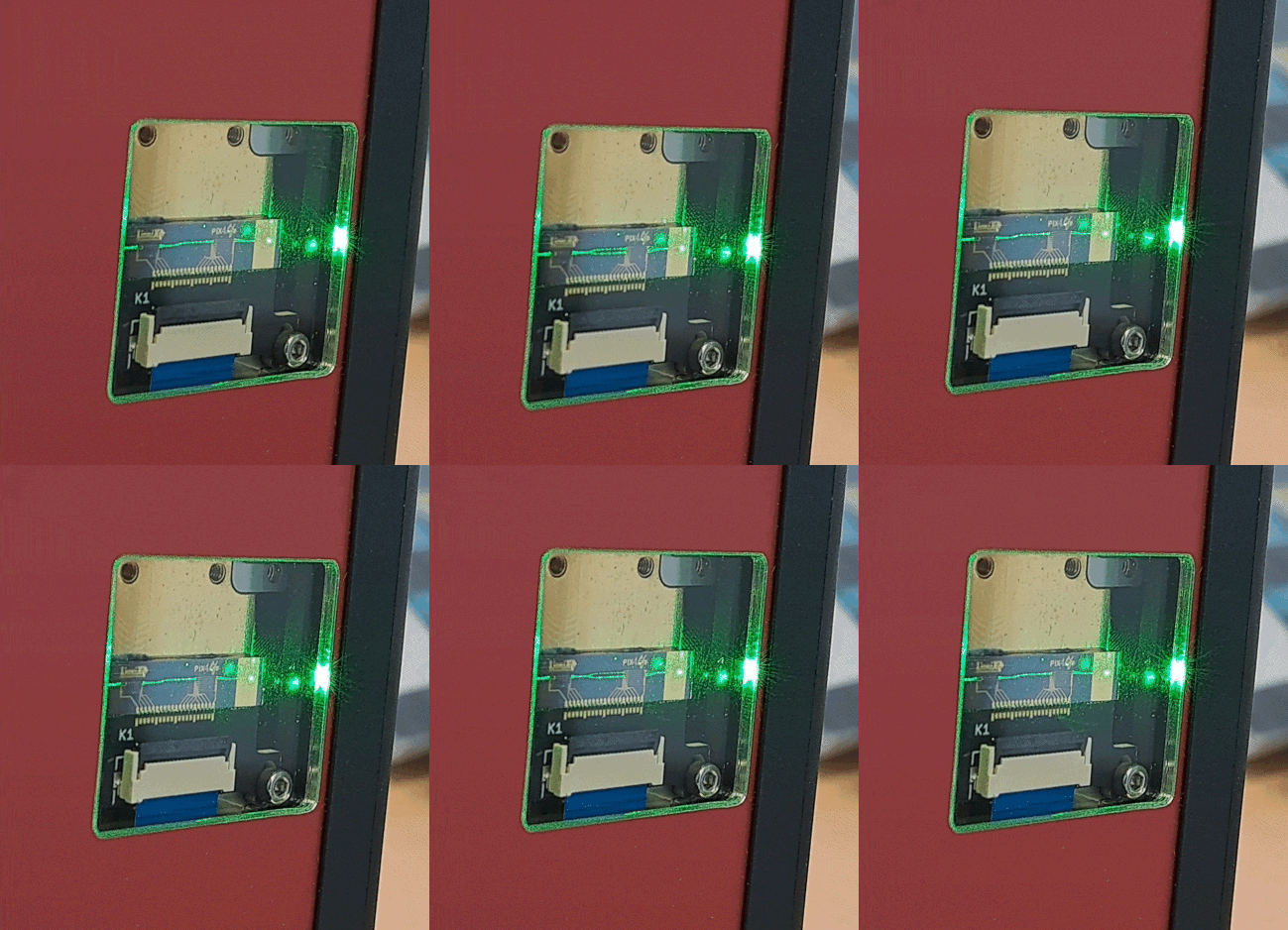
The structured light engine packaged with driving electronics, emitting light out-of-plane from the chip.

The sturctured light engine in its edge-emitting configuation, in a CPS package.
Find out more about photonic integrated circuits for AR/VR applications
What is AR/VR?
Augmented and virtual reality (AR/VR) involves the integration of interactive digital information with human vision via wearable heads-up and head-mounted displays. AR/VR enables an experience of the world enriched with visual information that offers thrilling experiences and valuable technical insights. From surgical procedures to gaming – the AR/VR market promises to deliver ground-breaking applications and billions of dollars of growth in the coming years.
Why use Photonic Integrated Circuits for AR/VR?
Whereas previous iterations of wearable displays were bulky, visually unappealing ugly, and performed poorly, the same is not true of the next generation. Several technologies, such as retinal projection, are improving the brightness and resolution of the wearables, with components slender enough to incorporate into stylish, everyday glasses.
A key enabler for AR/VR displays is robust, miniaturized optics – a perfect fit for Photonic Integrated Circuits (PICs). PIC technology produces optical components with very precise light control, in spatial position and optical properties, while remaining straight-forward to engineer and scalable to manufacture.
The batch micro- and nanofabrication processes used to manufacture PICs are easy to scale, with costs reducing as volumes increase. For high volume applications, costs of dollars per PIC are not uncommon.